India National Cricket Team vs South Africa National Cricket Team Match Scorecard
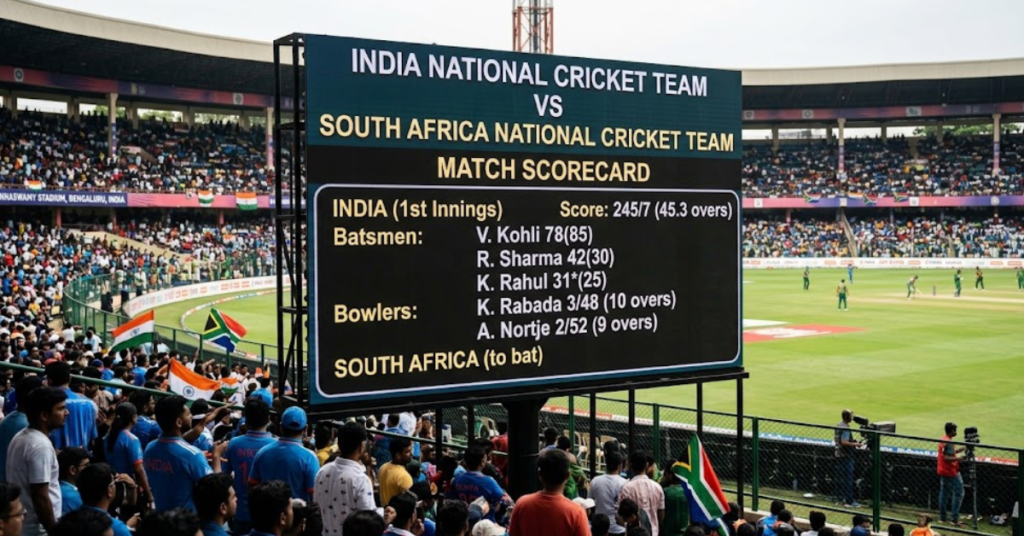
When India takes on South Africa, cricket fans can expect a fascinating contest between two competitive international sides. A quick look at the India national cricket team vs South Africa national cricket team match scorecard reveals the runs, wickets, partnerships, and individual performances that shape the result. But to understand why one team wins, you need to look beyond the final numbers.
India and South Africa compete across Test matches, One Day Internationals (ODIs), and Twenty20 Internationals (T20Is). Each format brings different challenges, from patient batting in Test cricket to aggressive stroke play and tight bowling in limited-overs games.
In this guide, you’ll learn how to find the correct match scorecard, understand the most important statistics, compare performances from both teams, and explore the head-to-head rivalry. Since these teams meet in multiple series and tournaments, always check the match date and format when searching for a particular result.
India vs South Africa Match Scorecard: Match Overview
A cricket scorecard provides a structured summary of a match. It records the team’s innings, individual batting scores, bowling figures, extras, fall of wickets, and the final result.
Before examining the numbers, check the basic match information to make sure you’re viewing the right fixture.
A full match overview generally includes:
- Teams: India and South Africa.
- Match format: Test, ODI, or T20I.
- Date and venue: When and where the match took place.
- Toss result: Which captain won the toss and chose to bat or bowl.
- Innings totals: Runs scored and wickets lost by each team.
- Batting performance: Individual scores, boundaries, and strike rates.
- Bowling performance: Overs, runs conceded, wickets, and economy rates.
- Match result: The winner and margin of victory, or a draw or tie where applicable.
- Player of the Match: The player recognized for an outstanding contribution.
These details make it easier to follow a live game, review a completed match, or research a historical contest between the two teams.
India National Cricket Team Batting Scorecard
India’s batting scorecard shows how each player contributed to the team’s innings. It helps identify the top scorer, the most productive partnerships, and the batters who accelerated the scoring rate.
Key batting statistics
| Statistic | Meaning |
| Runs (R) | Total runs scored by the batter |
| Balls (B) | Legal deliveries faced |
| Fours (4s) | Number of boundaries hit for four |
| Sixes (6s) | Number of sixes hit |
| Strike Rate (SR) | Runs scored per 100 balls faced |
| Dismissal | How the batter was out |
A batter’s individual score is important, but context matters. A patient innings can be crucial in a challenging Test match, while a quick contribution may prove more valuable during a T20 chase.
When reviewing India’s batting performance, pay attention to the opening partnership, the stability of the middle order, and the runs scored during the final overs in limited-overs matches.
South Africa National Cricket Team Batting Scorecard
South Africa’s batting scorecard provides the same essential information, allowing readers to compare its performance directly with India’s.
The most useful details include:
- The highest individual score.
- The number of batters who made meaningful contributions.
- The number and timing of wickets lost.
- The scoring rate during different stages of the innings.
- Partnerships that helped rebuild or accelerate the innings.
For example, a strong opening partnership can give South Africa a solid foundation, but losing several wickets in quick succession may leave the middle order under pressure.
Likewise, a late surge in scoring can turn an average-looking total into a challenging target. Reading the full innings rather than focusing only on the top scorer gives a more accurate picture of the team’s performance.
India vs South Africa Bowling Scorecard
Batting often attracts the most attention, but bowling figures can explain why a match turned in one team’s favor.
A bowling scorecard shows how many overs each bowler delivered, how many runs they conceded, and how many wickets they took.
| Statistic | Meaning |
| Overs (O) | Overs bowled |
| Maidens (M) | Overs in which no runs were conceded |
| Runs (R) | Runs conceded by the bowler |
| Wickets (W) | Wickets credited to the bowler |
| Economy (Econ) | Average runs conceded per over |
How to identify the best bowling performance
A bowler who takes several wickets can put the opposition under pressure, particularly when those wickets break important partnerships. However, wicket-taking is only one measure of success.
An economical spell can also be decisive by restricting scoring opportunities and forcing batters to take risks. To evaluate a bowling performance properly, consider the number of overs bowled, the conditions, the batters dismissed, and the stage of the match.
In Test cricket, sustained pressure and the ability to take 20 wickets can be essential. In ODIs and T20Is, controlling the scoring rate and taking wickets at key moments often determine the outcome.
India vs South Africa Scorecard in Test Cricket
Test cricket provides a different challenge from limited-overs formats. Matches can last up to five days, and each team may bat twice.
A Test match scorecard can therefore include four innings. To understand the result, readers need to examine the individual innings as well as the overall match situation.
What to look for in a Test scorecard
- First-innings total: The runs scored by each team in its first innings.
- Lead or deficit: The difference between the teams’ innings totals.
- Second-innings performance: Whether a team built its lead or recovered from a deficit.
- Bowling spells: Wickets taken across the match.
- Final result: A win, loss, draw, or tie.
Pitch conditions can change significantly over five days, influencing batting technique, spin, pace, and bounce. A score that looks modest in one innings may be valuable if the pitch becomes harder to bat on later.
India and South Africa have both produced memorable Test contests, with batting resilience and bowling discipline often playing decisive roles.
India vs South Africa ODI Match Scorecard
One Day Internationals generally allow each team a maximum of 50 overs, subject to playing conditions and interruptions.
In an ODI, a useful scorecard analysis considers both the total runs and how efficiently those runs were scored.
Key ODI statistics
- Total runs and wickets lost.
- Individual centuries and half-centuries.
- Run rate across the innings.
- Bowling economy and wickets taken.
- Partnerships during the middle overs.
- Runs scored during the final overs.
- Target and result during a successful or unsuccessful chase.
A team can post a large total but still struggle if its bowling attack cannot defend it. Similarly, a disciplined bowling performance can make a moderate target difficult to chase.
When comparing India and South Africa in an ODI, look at how each team performed with both bat and ball instead of judging the match from the first-innings total alone.
India vs South Africa T20I Match Scorecard
T20 Internationals are usually limited to 20 overs per team, making each phase of the innings important.
A T20I scorecard helps fans assess how quickly a team scored, when wickets fell, and whether the bowling side controlled the crucial overs.
Important T20I match statistics
Powerplay: The first six overs of a standard T20 innings, when fielding restrictions influence scoring opportunities.
Strike rate: A measure of how quickly a batter scores runs.
Economy rate: The average number of runs a bowler concedes per over.
Death overs: The closing overs, when batters often attempt to score quickly and bowlers try to restrict boundaries.
A fast-scoring innings can create momentum, but wickets in hand are equally important. A team chasing a target must balance aggressive scoring with the risk of losing batters too quickly.
India vs South Africa Head-to-Head Record
The head-to-head record helps fans compare the teams’ previous encounters and understand their history across international cricket.
However, the numbers differ depending on whether you’re examining Tests, ODIs, or T20Is. Each format has its own match history, and the overall record can change as new fixtures are played.
When researching the India vs South Africa head-to-head record, check:
- Total matches played in the selected format.
- Wins by India.
- Wins by South Africa.
- Draws, ties, or abandoned matches, where applicable.
- Recent series results.
- Performance in ICC tournaments compared with bilateral series.
For accurate figures, use a reputable cricket statistics database and verify the selected date range. Avoid combining statistics from different formats without clearly identifying them.
Past results offer useful context, but they cannot guarantee the outcome of a future match. Player availability, current form, pitch conditions, and the venue all influence how a new contest unfolds.
Where to Find the Latest India vs South Africa Match Scorecard
If you’re looking for live scores, completed match results, or historical scorecards, several established cricket websites provide detailed coverage.
- BCCI official website: India team fixtures, results, and official updates.
- Cricket South Africa: South African team news, schedules, and match information.
- ESPNcricinfo: Detailed scorecards, player statistics, ball-by-ball commentary, and historical records.
- Cricbuzz: Live scores, match summaries, and series coverage.
- ICC official website: International tournament fixtures, results, and official match coverage.
To find a specific match quickly, search for both team names along with the match date, tournament, or format. This is especially helpful when the teams have played multiple matches during the same tour.
How to Analyze an India vs South Africa Cricket Match
Reading a scorecard becomes much more useful when you connect the statistics to the events on the field.
Follow these steps to understand a match more clearly:
- Check the match details. Confirm the date, format, venue, and toss result.
- Compare the innings totals. Look at the runs scored and wickets lost by both teams.
- Identify the leading batters. Compare runs, balls faced, boundaries, and strike rates.
- Review the bowling figures. Look for wicket-taking spells and economical performances.
- Study the partnerships. Identify periods when a team built momentum or recovered from setbacks.
- Examine the key overs. In limited-overs matches, the powerplay and death overs often reveal important turning points.
- Read the final result. Check the winning margin and Player of the Match award, if applicable.
Combining these details with ball-by-ball commentary helps explain why the match developed as it did.
Frequently Asked Questions (FAQs)
1. Where can I find the India vs South Africa cricket match scorecard?
You can find scorecards on ESPNcricinfo, Cricbuzz, and the official BCCI, Cricket South Africa, or ICC websites. Select the correct date and format to view the relevant match.
2. How can I check the live India vs South Africa score?
Visit a reputable live-score service such as ESPNcricinfo or Cricbuzz during the match. Official cricket board and ICC websites may also provide live coverage or match updates.
3. What information does an India vs South Africa scorecard include?
A full scorecard generally contains innings totals, individual batting scores, bowling figures, extras, partnerships, fall of wickets, and the final result. It may also include the toss, playing XIs, and Player of the Match.
4. What does 250/7 mean in a cricket scorecard?
It means the team scored 250 runs and lost seven wickets. In a standard ODI innings, the opposition would generally need 251 runs to win, subject to any applicable adjustments to the target.
5. How do I find the highest scorer in an India vs South Africa match?
Check the batting section and compare the runs scored by each player. The batter with the highest individual score is the innings’ leading run-scorer.
6. Where can I check India vs South Africa head-to-head statistics?
Established cricket databases, including ESPNcricinfo, provide historical match records. Select the format and relevant date range to avoid mixing Test, ODI, and T20I results.
7. Why are India vs South Africa Test and ODI scorecards different?
A Test match may feature two innings per team and can end in a draw. An ODI generally has one innings per team, with each side allowed up to 50 overs under standard playing conditions.
8. Does the scorecard show the Player of the Match?
Many full scorecards and match summaries include the Player of the Match award. The award recognizes a significant contribution through batting, bowling, fielding, or an all-round performance.
Conclusion
The India national cricket team vs South Africa national cricket team match scorecard is an essential resource for fans who want to understand more than just the final result. It reveals the leading batters, most effective bowlers, important partnerships, and turning points that shaped the contest.
Whether you’re following a Test series, an ODI, or a T20I, reviewing the innings totals alongside individual performances and match conditions provides a clearer picture of how the game was won or lost.
For accurate results, use trusted cricket websites and verify the exact fixture before quoting statistics. Explore historical scorecards, compare performances across formats, and follow upcoming India vs South Africa matches to stay informed about one of international cricket’s most compelling rivalries.